

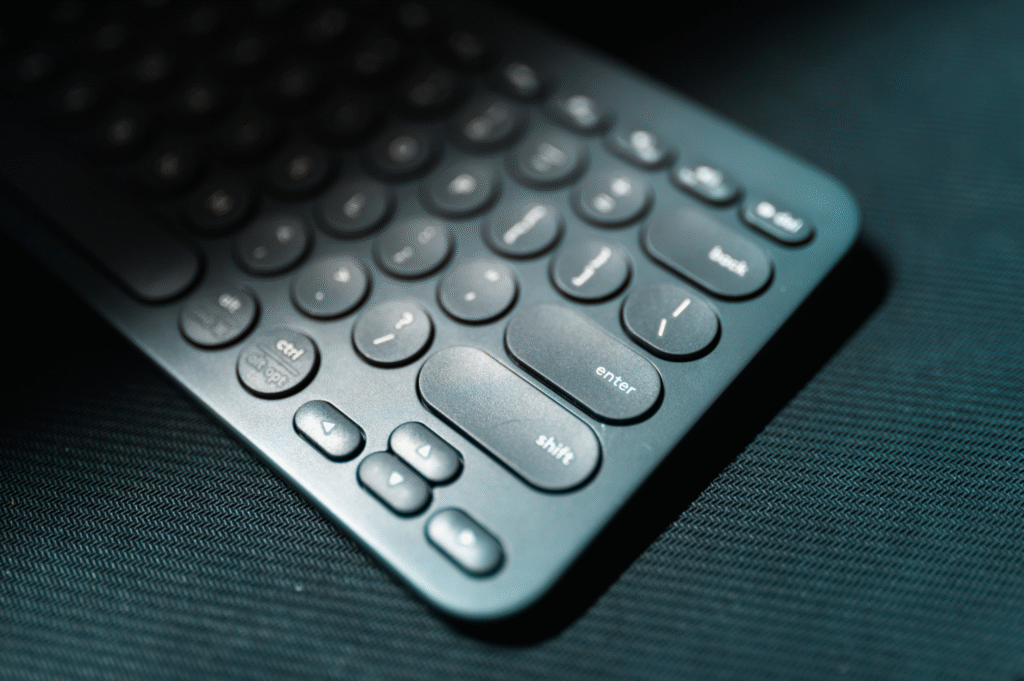
Understanding how key travel distance affects user experience and productivity in different use cases.
Key travel—the distance a key moves from its resting position to its actuation point—is perhaps the most visceral element of the keyboard user experience. It’s a design choice that often goes unnoticed until it’s “wrong,” leading to discomfort, typing errors, or fatigue.
For keyboard designers and Original Design Manufacturers (ODMs), mastering the psychology of key travel means understanding how subtle differences in distance translate into vastly different user perceptions of quality, speed, and comfort across various use cases.
The Spectrum of Key Travel
Key travel falls into a spectrum defined primarily by two categories: deep and shallow. Each category appeals to a specific user demographic and typing environment.
1. Deep Travel (3.5mm – 4.0mm)
Characteristics: Typically found in traditional mechanical and ergonomic keyboards.
Perception: Deep travel provides a strong sense of tactile feedback and intentionality. The user perceives the key press as robust and trustworthy, equating the physical distance with durability and precision.
Psychological Impact: The longer path allows the finger to absorb impact gradually, leading to a feeling of comfort and reduced fatigue over extended typing sessions. This is ideal for professional writers, coders, and users who prioritize typing accuracy over pure speed.
2. Shallow Travel (0.5mm – 1.5mm)
Characteristics: Common in modern laptops and ultra-slim profile keyboards (often using scissor or low-profile mechanical switches).
Perception: Shallow travel is associated with speed and modernity. The reduced distance allows for faster key cycling, maximizing raw WPM (Words Per Minute) potential. The key press is often perceived as “snappy” or “responsive.”
Psychological Impact: For users accustomed to touchscreens or laptop typing, the minimal movement provides a feeling of efficiency and effortless input. However, it also increases the risk of “bottoming out” (hitting the base plate hard), which can lead to finger soreness if the actuation force is too high.
Matching Travel to Use Case
A successful keyboard design relies on matching the optimal key travel to the intended user’s primary activity:
| Use Case | Ideal Key Travel | Rationale |
| Professional Typing/Coding | Medium to Deep (3.0mm – 4.0mm) | Prioritizes comfort and physical confirmation (tactile bump). The reduced speed is an acceptable trade-off for longevity. |
| Mobile/Travel | Shallow (0.8mm – 1.5mm) | Necessitated by the slim form factor. Users expect a fast, crisp press that minimizes bulk. |
| High-Action Gaming | Medium to Deep (2.0mm – 3.5mm) | Needs a compromise. Travel should be long enough to prevent accidental presses, but short enough for rapid fire actions (often achieved with specialized gaming switches). |
| Office/General Use | Medium (2.0mm – 3.0mm) | Seeks balance. Must satisfy both speed requirements (email) and comfort expectations (longer documents). |
The Role of Actuation Force
Key travel cannot be separated from actuation force (the pressure required to register a press). The psychology is this:
Deep Travel + High Force: Feels heavy and deliberate (like a vintage keyboard).
Shallow Travel + Low Force: Feels light and dangerously fast (high risk of typos).
The perfect balance is achieved when the actuation force ramps up quickly enough to provide satisfying feedback before the finger fully bottoms out, regardless of the travel distance. This allows the user’s brain to confirm the input without unnecessary physical strain.
Conclusion
Designing key travel is an exercise in applied psychology and physics. For ODM clients, understanding whether their target demographic values the reassuring clack of deep travel or the rapid efficiency of shallow travel is paramount. The ultimate goal is to create a typing experience so intuitive and comfortable that the user stops noticing the keys and simply focuses on the task at hand.
Looking to optimize your next peripheral line for a specific user experience? Contact our design insights team to discuss customized switch and key travel specifications.